


Most homeowners don’t think about dockworkers when their garage door stops working. The problem feels local, personal, and urgent: the door won’t open, the car is trapped, the house feels exposed. A technician arrives, tools in hand, fixes the issue, and life moves on.
But behind that quiet moment of relief is a long, mostly invisible chain of labor that starts far from the driveway—often at the ports.
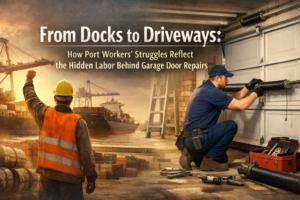
When West Coast port workers organized shutdowns to demand safer conditions, fair pay, and basic respect, the headlines focused on shipping delays and economic disruption. What rarely made the news was how deeply their struggle mirrors the reality of tradespeople and technicians across the country, including those who install and repair garage doors every day.
The unseen hands behind everyday convenience
Garage doors look simple. Panels, tracks, springs, openers. But nearly every component has traveled thousands of miles, passed through ports, warehouses, trucks, and workshops before it reaches a home.
Port workers move the steel that becomes door panels. They unload the motors that power openers. They handle the raw materials used for springs, rollers, and safety systems. When ports slow down or shut down, it’s not just “the supply chain” that feels it—it’s real people, on both ends.
Garage door technicians feel it when parts are backordered. Homeowners feel it when repairs take longer or cost more. And port workers feel it first, in their bodies, schedules, and paychecks.
Shared struggles across different jobs
On the surface, dockworkers and garage door technicians live in different worlds. One works massive cranes and cargo ships; the other works in residential neighborhoods. But their realities overlap more than most people realize.
Both rely on physical labor that wears down the body. Both work in environments where safety is critical and mistakes can be dangerous. Both face pressure to work faster, cheaper, and longer, often while the true value of their labor is overlooked.
When port workers demand respect, they aren’t asking for special treatment. They’re asking for what many skilled trades have quietly needed for years: recognition that essential work deserves fair conditions.
Why disruptions reveal the truth
Port shutdowns frustrate consumers because they expose how dependent modern life is on workers we rarely see. Suddenly, things don’t arrive on time. Repairs take longer. Costs rise.
But those disruptions don’t create the problem—they reveal it.
The same is true in garage door repair Watchung, NJ. When a spring breaks or a motor fails, homeowners suddenly notice how critical that system is to daily life. Only then does the quiet labor behind it become visible.
Moments of inconvenience have a way of shining a light on labor that’s been invisible all along.
Respect doesn’t stop at the front door
It’s easy to think of labor issues as something distant—happening at ports, factories, or protests on the news. But the values behind those movements show up much closer to home.
Choosing qualified technicians, respecting fair pricing, understanding delays, and valuing skilled work are all ways homeowners participate in the same conversation port workers started. It’s about recognizing that reliability, safety, and quality don’t happen by accident—they’re built by people.
From docks to driveways, modern life runs on hands that lift, carry, fix, and protect. When those workers ask to be seen, it’s worth listening.
The bigger picture behind a simple repair
The next time a garage door opens smoothly after a repair, it’s not just a mechanical success. It’s the end result of countless workers doing demanding jobs across continents and industries.
Port workers standing up for better conditions aren’t just fighting for themselves. They’re reminding us that behind every convenience is labor—and labor deserves dignity.
Even in something as ordinary as a garage door.